Part 1 of 2
Back in 1989, a consultant named Sidney Yoshida published a study that people in business have been citing ever since. The original research is hard to track down but Yoshida allegedly looked at how a Japanese car manufacturer called Calsonic was run, and found that:
Frontline workers know about 100% of the problems in their organization. Their supervisors know about 74%. Middle management knows about 9%. And senior executives just about 4%.
He called it the Iceberg of Ignorance.
Whether his exact numbers hold for every company is up for debate, but the idea has stuck around for over 30 years because it describes something anyone who's spent real time inside a large company immediately recognizes.
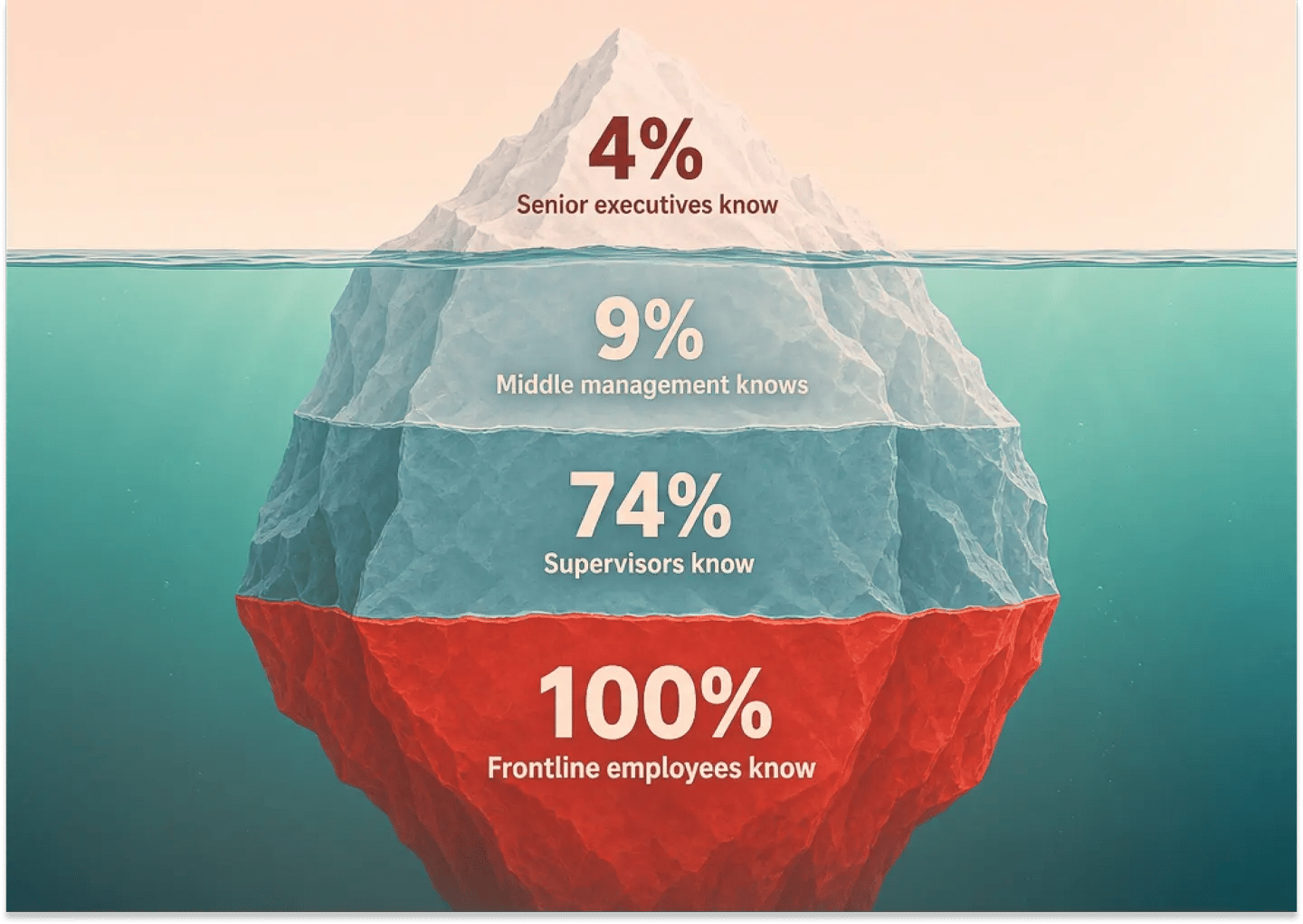
What leadership sees (the issues that got escalated, the reports that made it through, the numbers on the dashboard) that's the tip of the iceberg. The rest of it, the bulk of what's actually going on in the business, sits below the waterline where nobody at the top can see it.
The exact percentages may not hold in your company. Maybe you're at 6% instead of 4%, it doesn't really matter, the direction is what matters, and nobody who's spent real time inside a large organization seriously argues with it.
The higher up you go, the less you see of what's happening on the floor because your attention is legitimately pulled in other directions. You're closer to the board, the financials, the market, and the strategy. That's exactly where you should be. What moves further away is the day-to-day operational reality of the people doing the actual work, and that's the part the iceberg is about.
This analogy raises an uncomfortable question: what's sitting below your waterline right now?
The Iceberg Doesn't Form by Accident
When leaders hear this, the first response is often that the iceberg doesn't really apply to them. Issues do get found and dealt with in the layers below, they'll say — and they're right about that. Problems get solved every shift. Supervisors patch broken processes and teams adapt. That's an organization functioning the way it's designed to.
What's harder to see, and what no reporting structure surfaces, is what happens to the good ideas like the improvement one team quietly figured out and implemented on their floor. Or the fix that saved real time in one location but never traveled to the twelve others running the same process.
That's what the iceberg is actually about, the value nobody captured.
The iceberg doesn't form because of bad intentions or poor culture. Companies with genuinely good leadership, places where people actually like coming to work, have this exact same problem. It forms because of 3 specific forces that are at work inside almost every large, multi-location operation:
The first force: the information gets filtered on the way up
When something goes wrong on the floor, the person who sees it has to decide whether to say something or not, and that decision isn't as simple as it sounds.
If raising the issue could reflect poorly on their team's numbers, or draw attention to something that's been going on for a while, the path of least resistance is to manage it quietly rather than escalate it. They’re not trying to hide anything — that's just the safer call in some organizations.
Then their manager does the same thing, and her manager, and by the time the information gets to someone who could actually do something about it, it's been through 4-5 pairs of hands, each one filtering the information through their own understanding of what's worth raising and what will just cause friction.
A study published in the Journal of Management Studies found that 85% of employees said they'd been in situations where they felt like they couldn't raise something important to their boss — even when they knew it mattered. And here's the part that really lands: once one person decides to stay quiet, everyone around them who knows the same thing tends to quietly reach the same conclusion. Silence just becomes the norm.
That’s what happens when the system isn't designed to move bad news upward intact.
The second force: learned silence. They tried, and nothing happened
This one is harder to see from the top, and it's probably the most common reason the iceberg stays frozen.
Back in the 1960s, psychologist Martin Seligman did research showing that when people — and animals — try to change something and consistently fail, they eventually stop trying. Even when the situation changes and they could actually make a difference, they've already learned that it's not worth the effort.
That same thing happens in your operation every day.
An employee spots a recurring problem, she mentions it to someone, and nothing changes. She mentions it again, still nothing. After a few rounds of that, she stops mentioning it because the evidence in front of her says it's pointless.
From the outside, that looks like someone who doesn't care, but it isn't. She still sees the problem on every shift. The knowledge is still there, alive and updated; what's gone is any reason to surface it.
This is also why suggestion boxes and feedback portals so often make things worse. When people put in ideas and hear nothing back, they don't think "the portal is a bad tool," they think "speaking up doesn't work here." And that belief is hard to shake, because they formed it from experience.
The third force: for most frontline workers, there was never a way to speak up at all
This is the layer that surprises people most.
Research shows that more than 83% of frontline workers don't have a company email address, and nearly half have no access to the company intranet when they're at work. Town halls happen on schedules that don't account for shift workers. Feedback portals need logins that were never set up. The suggestion box is at the corporate office — which most of these employees have never set foot in.
These aren't people who are choosing not to say something, there was just never a way for them to say it.
And here's what makes this particularly frustrating: most leaders genuinely believe they're doing a good job of communicating with their frontline. In one study, 65% of frontline leaders said their communication approach was working well, but only 35% of frontline workers agreed.
That gap exists because the tools that work fine for office employees just don't reach the people actually running your operation.
5 Things Below Your Waterline Right Now
When we talk about what's below the waterline, we mean specific, operational things that your people have already noticed, adapted to, or quietly solved — on their own, at their level — but that never traveled to the people who could act on them at scale.
Workarounds nobody reported
In nearly every company we've worked with, employees have added steps to processes that broke somewhere upstream and never got fixed.
That workaround means someone figured out how to keep the work moving when the official process failed them. It's now standard practice on their floor, but it was never reported, evaluated, or standardized, so the broken process upstream stays broken, and people just work around it. Everyone doing the work knows about it, but there's no mechanism to move that knowledge to the people who could fix the root cause.
The real reason quality dips
Your reports show you when defect rates go up. The people on the floor not only know what causes it, they've learned to manage around it.
Experienced workers know which combination of shift, equipment state, and inputs sends things sideways, and they adjust. That's handling it, but that institutional knowledge lives in a handful of people and has never been captured, which means the upstream cause never gets fixed and the organization keeps depending on individual expertise to absorb a systemic problem.
Time being wasted every shift
Idle time, redundant steps, scheduling gaps, issues that cost real money every single day — employees dealt with this too. They absorbed it, adjusted their pace, and worked around it. They stopped raising issues because experience taught them that flagging it didn't lead anywhere. So the waste got quietly normalized into the workflow instead of eliminated.
Risks that became normal
If a safety concern gets raised again and again and nothing happens, eventually it becomes part of how things are done. It stops feeling like a risk worth flagging, but it's still a risk.
Two teams solving the same problem
One department builds a fix but another department, two buildings over or two locations away, is working on the exact same thing. The employee who touches both sides knows, but there was no system to surface that connection to the people who could act on it.
These issues aren't rare edge cases. We've seen some version of every one of them in almost every organization we've worked inside. The information needed to fix them is there, it's always there, what's missing is a path for it to travel from the level where it's being handled to the level where it could be standardized, scaled, or solved properly.
How to Know Which Layer Is Building Your Iceberg
Some organizations are dealing with all three forces at once, but usually one is doing most of the damage.
If it's mostly the filtering problem:
Think about the last time you learned something significant about your operation from a frontline employee directly — a site visit, a chance conversation, an offhand comment in a walkthrough — that hadn't come up in any manager report or escalation. If that's happened more than once, filtering is probably your main contributor.
And here's the thing worth understanding about why: your supervisor almost certainly didn't have the full picture either. The same force that shapes what reaches you is shaping what reaches her from the level below. She's working with what made it through to her — and somewhere in that chain, the full story got narrowed down. That's the iceberg doing what the iceberg does at every single level.
If learned silence is the bigger issue:
Think about the last feedback initiative or idea program your company ran. How long did people actually use it before it quietly faded out? If the answer is a few weeks, learned silence may be your problem. People participated, saw what happened (or didn't happen) with their ideas, and drew their own conclusions. That conclusion is now doing more damage than any tool problem.
If access is the real barrier:
How many of your people could actually raise a concern or share an idea right now, from wherever they're working, without going through a manager? For most multi-location, shift-heavy operations, the answer is a pretty small percentage of the total headcount. The rest have no real path to be heard because nobody built one for them.
The Price Tag Is Real — It Just Doesn't Show Up on Any Report
McKinsey estimates that somewhere between 20 and 30% of operating expenses get eaten up by inefficiency. Deloitte’s annual Human Capital Trends Report also found that managers spend around 40% of their time dealing with internal issues that shouldn't need their attention at all. A big chunk of both those numbers comes from problems people in the organization already know about — problems that never surfaced because no clear path existed to move them upward.
The Milliken and Morrison research found that 85% of employees had, at some point, kept something to themselves that they knew the organization needed to hear. That's not a small group of disengaged outliers, that's almost everyone sitting on information that would help the business — and saying nothing, because either the system taught them it wasn't worth saying or they don’t have a way to do it.
Beyond inefficiency, the cost is the employee who leaves because nobody ever seemed to care what she thought. It's the safety incident that started as a small risk everyone stopped reporting. It's the improvement program that addressed the wrong problem because the real one never made it into the room.
None of it shows up anywhere as a number, but all of it is real.
Most Listening Tools Were Built for the Tip
When companies recognize the iceberg, the first move is usually an employee listening initiative like an anonymous feedback channel. For the employees who already have a channel (the ones with email access, who attend the all-hands, or who are used to being in the room) those tools pick up something useful.
But for everyone else, the iceberg stays right where it is.
A town hall is a broadcast with some Q&A built in — it’s not meant to pull operational problems out of a 500-person workforce across six locations. A survey works when people trust the anonymity is real and have a way to access it. But for a lot of frontline workers, neither of those things is true.
The uncomfortable truth is that most employee listening tools were built to reach the tip of the iceberg. They were never designed for the layers underneath — the filtered information, the trained-out voice, the workforce that just never had a microphone.
Culture still matters, but culture alone can't replace a system that was never built for this job.
The Knowledge Is Already There — It Just Hasn't Had a Way to Reach You
Lew Platt, former CEO of HP, once put it this way:
"If only HP knew what HP knows, we would be three times more productive."
That's the iceberg in one sentence.
The knowledge is there, in your operation, right now, in the heads of the people closest to the work. They see the workarounds, the waste, the risks, the missed opportunities. They've always seen them.
The opportunity is making sure that knowledge actually gets to the people who can do something with it.
In 30+ years of working inside manufacturing plants, retail chains, banks, and distribution operations, we have never once walked into a company where the employees didn't have insight into what needed to improve. The ideas were always there.
What most companies have never built is a reliable way to get what's underwater to the surface.
That's what Part 2 is about.
Continue to Part 2: Melting the Iceberg of Ignorance →