Tell Jules vs management consultants
Your people have the ideas. The consultants have the invoice
Full disclosure: we used to be the consultants.
No IT project needed. All you need is a business email.

Management consultants

Where the answer gets lost
Consulting is an expensive game of telephone
Here’s how a fix your team could test tomorrow ends up on slide 47.
What your employee said
“Switching the line to a new product takes two hours. If we prep the next run’s parts while the current one finishes, we’d get it down to 40 minutes.”
What reaches you
Slide 47 of 212 says “Explore throughput optimization.” The 40-minute fix is gone.
How the fix got lost
-
Junior consultant
“Long changeovers”
Interviews 37 of 40. Writes down “long changeovers.” The 40-minute fix doesn’t make it into the notes.
-
Engagement lead
“Operational inefficiency”
Files it with 30 other notes under “operational inefficiency,” then puts it in a 2×2.
-
Partner
“Throughput variability”
Presents it to you as “throughput variability” and proposes a second phase to study it, billed at partner rates.
With Tell Jules, you hear about the 40-minute fix.
Talk with Jules nowThe real cost of hiring consultants
The invoice is just the first cost
The bigger costs come after the consultants leave: months of delay, advice that doesn’t fit how you work, budget that could have gone to people or equipment, and a team that stops telling you things.
You pay to get your own knowledge back
Your people explain how the business works. The firm puts it in a deck, takes its notes home, and can bill you to find it again.
You spend months getting buy-in
Your managers have to sell a plan to the same people who could have helped write it. Meanwhile, the changeover still takes two hours.
You live with the advice
If the reorg makes things worse, your team has to fix it. The invoice clears either way.
You get the next proposal before you know if the last one worked
The firm wraps up at the readout. Your team is still waiting to see if the numbers move.
The fee can cost you a hire
Six figures could pay for a supervisor, new equipment, or raises. The deck might recommend all three.
Your people take note
They spend weeks explaining their jobs, then watch someone else get credit for their ideas. Next time, the fix stays on the floor.
The fastest way to unite your people is to hire consultants. Everyone agrees they’d rather not have them.
What you gain with Tell Jules
With Tell Jules, you find costs you can cut and sales you can win back
See where you’re paying twice
Your people know which steps waste time, which expenses overlap, and which mistakes they fix every week. Jules brings you what they’d change.
Find out why customers walk away
Sales and service hear what buyers keep asking for and why deals fall through. Jules gets their ideas for winning that business back.
Catch problems while they’re cheap to fix
If entering the same information twice costs an hour a day, you can test a fix this month. Give it a year and it might get its own consulting proposal.
Keep your managers on the floor
Jules handles the conversations and notes. Your managers can spend that time deciding which fixes to try.
“What I liked about Jules was that it helped point us toward the themes and issues that were worth spending more time on.”
See the report for yourself
Try Jules yourself before you bring it to your team
Tell Jules about a real problem at work. It’ll ask follow-up questions and email you a report with the problem, your fix, and what you’d need to check before acting on it.
Just use your business email. The engagement letter can stay in the drawer.
Idea Harvest™ results vs consultant estimates
When a company asks the people who do the work, they find far more value than outside experts predicted
A large U.S. bank brought in three consulting firms. Each one came with its own fee, and all three landed on the same estimate. Then the bank asked its own employees.
Three times as much, and none of them sent an invoice. The answer was already in the building.
Tell Jules runs the asking part of that same Idea Harvest™ method, so you hear what your people know before you hire anyone to find it.
See the method behind the resultsTell Jules vs management consultants, side by side
One of these columns has a per diem
| What matters to you | Management consultants | Tell Jules |
|---|---|---|
| What do you get? | A deck with the firm’s recommendations. It may take 212 slides to get there. | A searchable list of problems, with your people’s fixes attached. |
| Where do the answers come from? | Interviews, the firm’s framework, and a benchmark that says you’re below average. | People who can tell you why and what they’d change. |
| What does it cost? | A large engagement can run six or seven figures before flights, hotels, and whatever happened at the minibar. | You can try it free with a business email. |
| How soon do you see findings? | A 12-week project can end with a readout. | You can start seeing findings in days. |
| Who pays if the advice is wrong? | You do. The invoice still clears. | You can check the numbers, risks, and teams involved before you spend. |
| Who do you hear from? | The people who fit on the interview calendar. | People across every site and shift, in 55+ languages. That includes the night crew. |
| Whose ideas do you get to test? | The firm’s recommendations, which your team has to put into practice. | Ideas from the people who’d put them into practice. |
| How much time does it take your people? | A scheduled interview, possibly followed by a workshop with sticky notes. | A call or chat when it suits them. They can bring one issue or ten. |
| What if you want another look? | You agree on a new scope and fee. | You run another round whenever you want. |
| Who does the asking? | A consulting team with a full calendar and a 5 p.m. flight. | Jules asks follow-ups based on your industry and your employees’ roles. |
| What do your people see afterward? | They get interviewed. They might hear what came of it at rollout. | Their input can reach someone who can act on it. They were right about the forklift. |
| What does it sound like? | “We’ve identified synergies to improve operational alignment.” | “The forklift has been broken since March.” |
Try it on your own problem
Try the right-hand column yourself
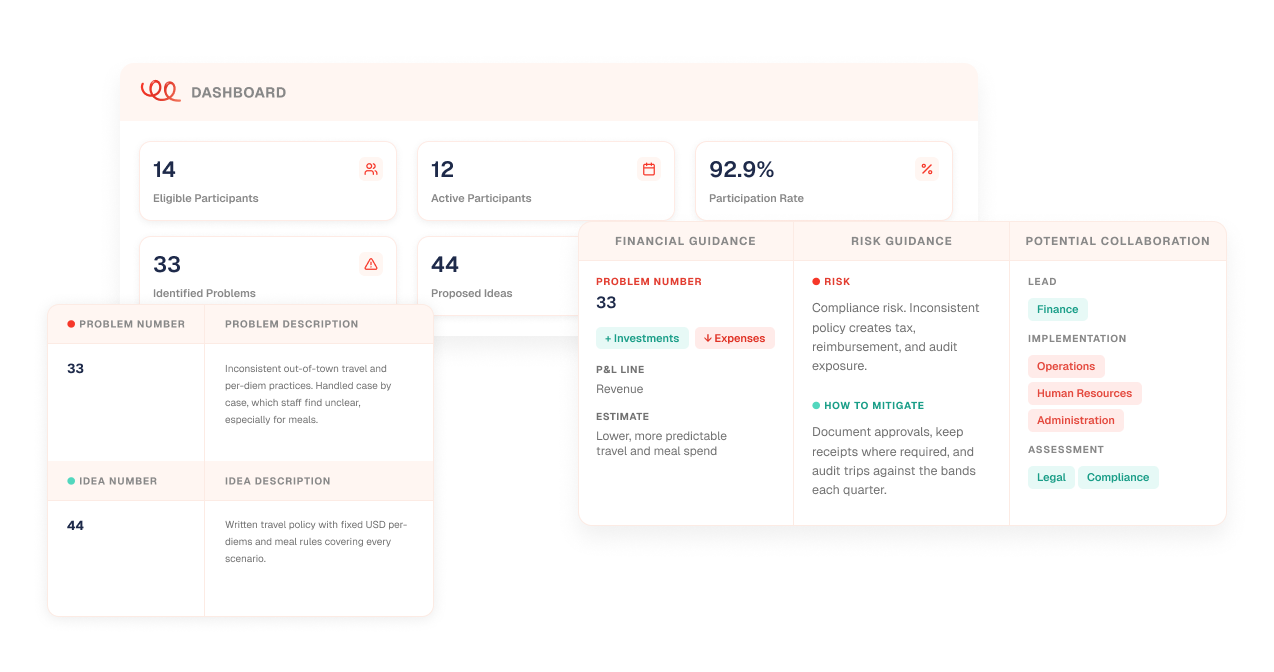
Talk or chat with Jules about a problem at work. You get the problem, your idea to fix it, and guidance on the financial impact, the risks, and which teams need to collaborate.
Keep sensitive findings in the right hands
Give people room to say what’s really happening
Let people speak confidentially or put their name on the idea
You choose. In confidential mode, you see what people shared and their names stay private.
Read the findings before anyone else does
You decide who sees them and when. Your board can hear about them from you.
Keep the focus on the work
Jules asks what’s getting in the way, what it costs, and what would fix it. Everyone stays out of the bottom-left corner of a 2×2.
Keep control of your data
Never used to train models. Handled in line with HIPAA and SOC 2. Jules never connects to your systems, so IT is happy.
What Tell Jules delivers instead of a consulting deck
What you get instead of 212 slides
Every problem in one list you can search
Search, sort, and filter employee feedback in the Jule Box to see where the same issue keeps coming up.
Your people’s fix, attached to each problem
Every suggested fix stays with the problem it’s meant to solve, in the employee’s own words.
Guidance for the budget meeting
Each idea comes with guidance on which numbers to check, what could go wrong, and who needs to be involved.
All of it in the Jule Box
Your team can comment, export findings, and agree on what to try, all from the Jule Box.
From the people who used to be the consultants
We apologize on behalf of your consultants
For the 212 slides, for “throughput variability,” and for making your people explain their jobs to someone with a 5 p.m. flight. We know how it happens. We built a few of those decks ourselves.
After nearly three decades of Idea Harvest™ with Fortune 1000 companies, we learned where to start. Ask the people who do the work what they’d change. We built Jules so you can do that yourself.
Want to talk to a human first? Book a call. We promise not to bring a deck.

Consulting, translated
A short glossary, for your next engagement
con·sul·tant
[ kən-ˈsəl-tᵊnt ] : noun
borrows your employees’ knowledge and sells it back with enough markup to cover the hotel
de·liv·er·able
[ di-ˈli-v(ə-)rə-bəl ] : noun
a document heavy enough to make the fee feel justified
dis·cov·ery phase
[ di-ˈskə-v(ə-)rē ˈfāz ] : noun
eight weeks spent finding information that was already in the building
steer·ing com·mit·tee
[ ˈstir-iŋ kə-ˈmi-tē ] : noun
meets every other Thursday to decide what employees need. Employees hear about it later
change man·age·ment
[ ˈchānj ˈma-nij-mənt ] : noun
the work of selling people on a decision they could have helped get right
scope
[ ˈskōp ] : noun
what both sides agree to before it grows
FAQ
A few things you might be wondering
Isn’t Tell Jules just a cheaper consultant?
Much, much cheaper, yes. A consultant, no. A consultant gives you their recommendations. Jules gives you your people’s problems and their fixes, unfiltered by a framework, a supposed outsider who doesn’t know your business, or a 2×2 matrix. Also, we don’t bill for the flight.
How long does a conversation take?
As long as the person has something to say. Tell Jules one issue or ten. Nobody is watching a clock, least of all Jules.
Will my people really be honest with Jules?
Yes. People are more honest with Jules than with an outside interviewer on the clock, and far more than on a survey with five circles. In confidential mode their name never reaches you, and they know it. In attributed mode they get recognized for honesty and insight.
Does Jules make anything up?
No. If no one mentioned “forklift,” there’s no “forklift” in Jules’ report. Jules is far better at telling you what your people said without worrying if it means losing the next gig.
We already do an annual engagement survey.
Keep it. A survey measures how people feel about work. We know. Everyone answered “3.” Jules asks for what gets in the way and what fixes it.
We have an open-door policy. Isn’t that enough?
An open door helps the people who walk through it. Jules reaches everyone else. How many people walked through your open door this year to tell you what problems they face? Jules asks everyone, one at a time, door closed.
Our consultants interview employees too. What’s different?
They interview forty. Jules can interview everyone, every shift, every site, 55 languages. They deliver 212 slides. Jules delivers a specific list of problems with your people’s fix attached.
What do I actually get?
Every problem and every fix your people suggested, plus jumpstart guidance about how to analyze the financials and the risks, plus who would need to collaborate to get the idea implemented. All in an app that’s easy to use: search it, sort it, export it. It won’t be a fancy, chart-filled deck. We consider this a feature.
Will my board take this seriously?
Boards take numbers seriously, and this one is hard to ignore: at a large U.S. bank, employees found three times what three consulting firms had estimated. See the numbers.
Is our data safe?
Never used to train models, handled in line with HIPAA and SOC 2, and Jules never connects to your systems. IT has nothing to install and nothing to object to, which IT may find a disorienting source of happiness.
Who built this?
A former McKinsey consultant and a former senior executive who had suffered at the hands of consultants one too many times, with almost three decades of Idea Harvest™. The answer usually sat across the table from us.
Isn’t Harvest Earnings a consulting firm?
Yes, and that’s where we learned this. Through Idea Harvest™, Harvest Earnings has spent almost three decades helping Fortune 1000 companies get ideas from their own people. Tell Jules takes the first stage of that method, asking your people, and lets you run it yourself, without hiring anyone.
How do I try it?
telljules.ai/try, with a business email. Tell Jules about a problem at work and watch it ask follow-ups. You’ll get a report that shows you what Jules produces for all conversations. Free, and nobody will circle back.
Try Tell Jules free
Bring Jules one problem. See what comes back
Talk or chat about something that costs your team time, money, or sales. You’ll get a write-up of what’s happening, what you’d change, and what to check before you spend a dollar on it.
It’s the same kind of conversation your people would have. All you need is a business email.
Free with a business email. Tell Jules 1 issue or 10. Jules has never once said “let’s circle back.”